Between 4 and 31 May 2026, EDUVIC led the pilot training of the European Hedera Erasmus+ project (2023-1-ES01-KA220-VET-000164938), a transdisciplinary programme aimed at social action professionals who want to gain tools for working on families’ relational health directly in their homes.
The project’s aim has been to design, implement and evaluate a family therapeutic intervention model with a solid theoretical basis and empirical evidence of its effectiveness. This first pilot edition made it possible to test both the content and the training format, and its results chart the course for future editions.
A 36-hour training with a competency-based approach
The training was organised into a total of 36 hours, split between a 4-hour introduction, four 30-hour modules and a 2-hour assessment block. The format combined synchronous sessions, both in-person and online, with independent work on Moodle, under a competency-based and experiential pedagogical approach, using Miller’s Pyramid as the evaluation framework. The training was free of charge for participants.
591 registrations and a highly diverse professional profile
The call for participants had a remarkable response: 591 registrations from professionals in the social, educational and health fields, of whom 64 people have already obtained certification by meeting the attendance and assessment criteria (figures closed as of 12 June 2026).
By professional background, social education is the largest group, accounting for 41% of registered participants, followed by psychology (24%), social work (21%) and other professional profiles (14%).
In terms of work setting, most participants work in child protection and social services, followed by family therapy, mental health, public administration, the third sector and education. In addition, just over half of registered participants (54%) already had prior training in systemic family therapy, confirming the sector’s interest in deepening its knowledge of relational intervention models.
Three synchronous sessions with high attendance
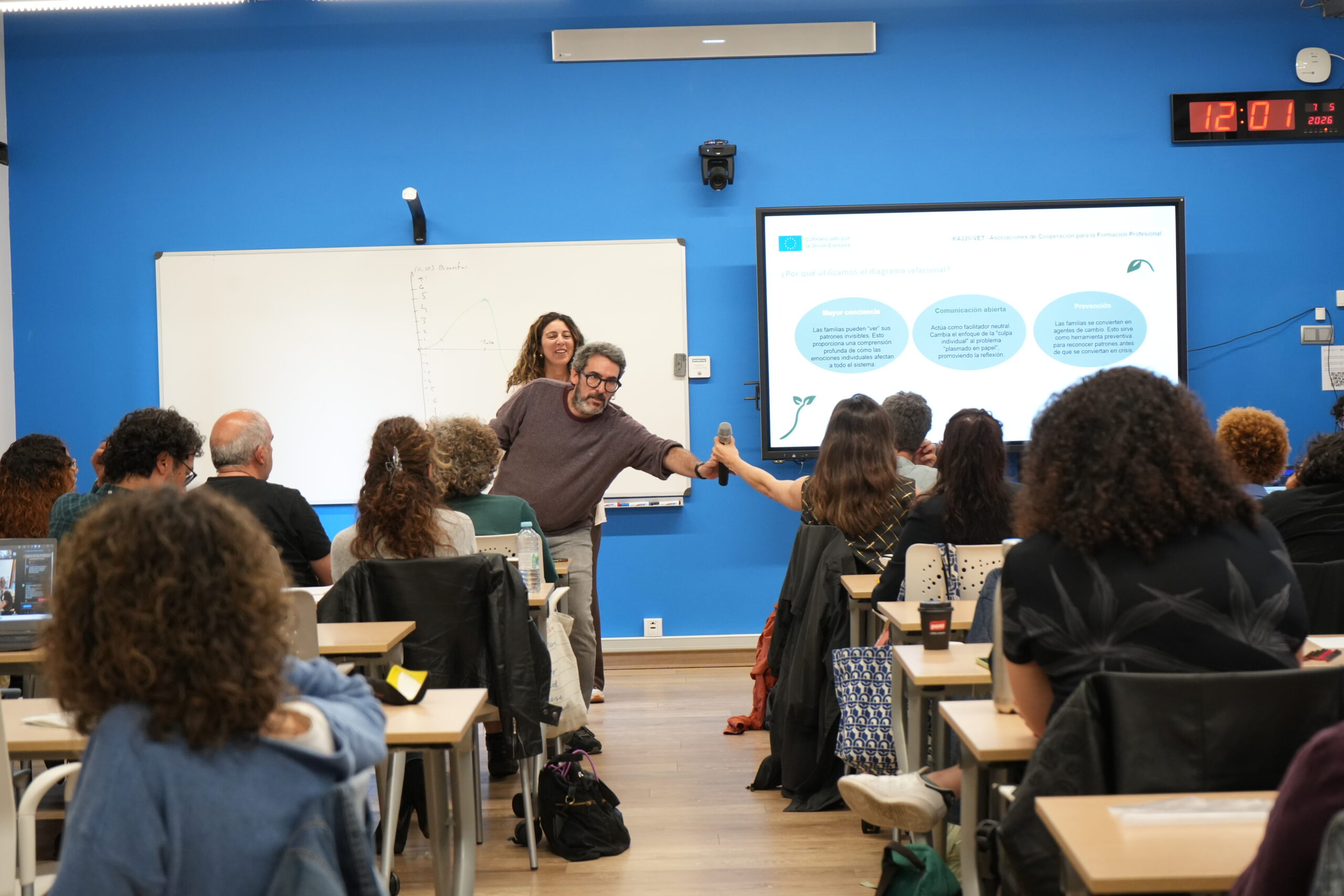
The synchronous part of the training took place over three sessions during May:
- 4 May — with Adela Camí, Javier Loyo and Nuria Molano (online).
- 7 May — with Marc Perales and Miriam Valero (in-person and online).
- 15 May — with Mateu Ubach and María Córcoles (in-person and online).
A largely positive final evaluation
In the final evaluation, participants rated both the training environment and its content very positively. The course venue was perceived as comfortable or very comfortable by the large majority, and those who attended in person reported no difficulty accessing the venue.
The content of the modules was perceived as very relevant or fairly relevant to family therapy practice, and the quality of interactions, both with the trainers and among participants, was rated mostly as very good or good.
What participants liked most: trainers, practice and materials
The analysis of the open-ended responses clearly shows the training’s key strengths:
- The trainers, praised for their professionalism, warmth and ability to convey knowledge from real experience, were named the course’s strongest point.
- The practical staging: role-plays, simulations and real examples of home-based intervention helped participants visualise the model in action.
- The materials and documentation, especially the PIRI and the intervention guides, were considered a valuable resource for day-to-day professional practice.
- The space for professional reflection generated a renewed outlook on participants’ own home-based practice.
The PIRI, the course’s most highly valued tool
Among all the course content, the Initial Relational Intervention Plan (PIRI) stands out as the most frequently mentioned and highest-rated resource. Its purpose is to organise the information gathered during each visit, turn vague complaints into concrete, measurable relational goals, and make it easier to track the intervention’s progress over time.
One participant summed it up this way: drawing up the PIRI, bringing together all the material covered in the previous modules, was of great help to her professional practice.
Areas for improvement: the hybrid format and time management
The constructive criticism centred on two very specific aspects:
- The hybrid format: some people who followed the course online reported difficulties taking part on equal terms in group dynamics and practical activities.
- Time and pacing: some participants asked for the course to be extended — especially the in-person part — and for the schedule to be concentrated on specific days to make attendance easier.
Occasional technical and organisational difficulties were also identified in the virtual breakout rooms, which at times reduced their effectiveness as a learning tool.
Did participants feel anything was missing?
Most of those who answered this question felt the course was sufficiently complete. Requests for additional content — greater depth on complex situations, family diversity, format, or the model’s theory — came mainly from participants with prior experience or advanced training in family therapy.
Conclusion: what to keep, what to improve and what to explore
The overall assessment of this first pilot edition of the Hedera training is clearly positive. Taken together, the responses allow the conclusions to be organised into three groups:
- Keep: the trainers’ profile, the practical approach with role-plays and real cases, low-cost techniques, the PIRI and the quality of the materials.
- Improve: management of the hybrid format, extending the time allotted to practical sessions, and improving the instructions for virtual group activities.
- Explore: more complex practical cases, content on high-resistance or crisis situations, cultural perspective and family diversity, and post-course follow-up spaces.
Many participants closed their comments with words of sincere thanks to the training and organising team — a clear sign that this first edition has generated real, meaningful learning for the social action professionals who work, every day, for families’ relational health.
Project co-funded by the European Union.